

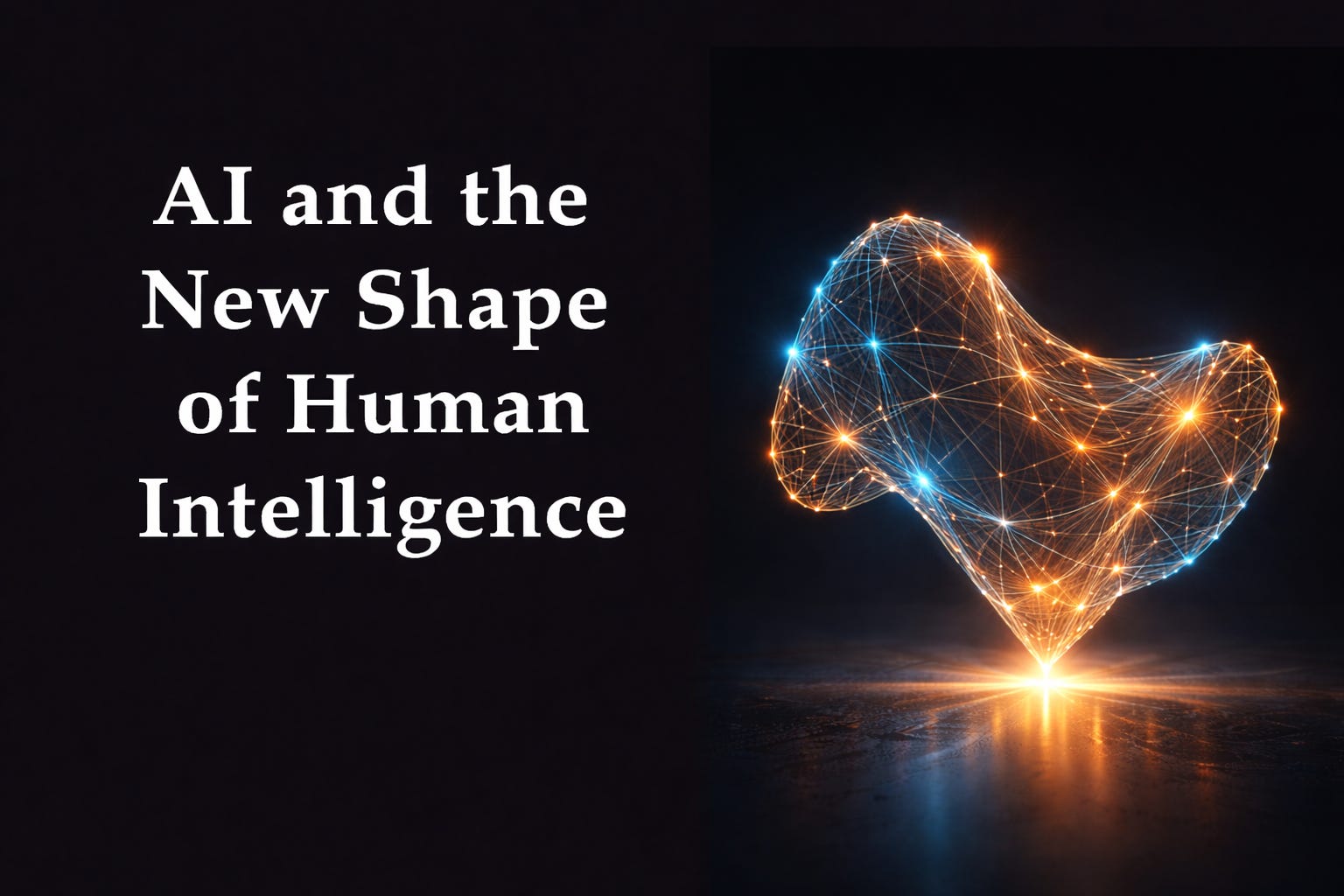
Will this technology make us more or less intelligent? It's the question on everyone's mind in the age of generative AI.
We worry about becoming too reliant on AI for basic tasks, yet we marvel at its ability to amplify our most complex creative and analytical work. We fear cognitive atrophy on one hand, and intellectual acceleration on the other. But this concern is not new at all.
We Have Been Here Before
Similar anxieties surfaced in the 1950s and 1960s, when early researchers began developing the first AI programs and speculating about machine intelligence.
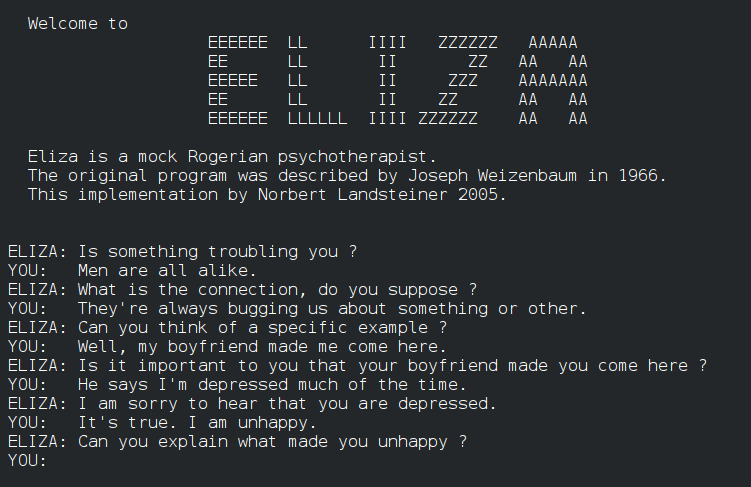
In 1966, programs like ELIZA, one of the world's first chatbots, demonstrated simple conversational AI. Created by Joseph Weizenbaum as an experiment to explore communication between humans and machines, the program produced unexpected reactions. To Weizenbaum’s surprise, some users, including his secretary, attributed human-like understanding and emotions to the system, a phenomenon that later became known as the ELIZA effect.
This image shows ELIZA in action, one of the earliest attempts to simulate human conversation through a psychotherapist-style dialogue system:
The fear that machines will replace thinking assumes that intelligence is a single and fragile capacity. But as Dr. Marvin Minsky, one of the founding figures of artificial intelligence and a co-founder of the MIT Artificial Intelligence Laboratory, once observed:
“What magical trick makes us intelligent? The trick is that there is no trick. The power of intelligence stems from our vast diversity, not from any single perfect principle.
There's no single secret sauce that makes us intelligent. Intelligence comes from having many different capabilities, processes, and approaches working together. It's the combination and interaction of diverse cognitive abilities that creates what we recognize as intelligence.
The recurring fears around AI and intelligence returned in the 1980s with AI Expert systems (DENDRAL), again in the 1990s with Neural Networks, and once more in the 2010s with Deep Learning.
As neural networks regained popularity in the 1990s, the fear was no longer that machines followed rules too rigidly, but that they learned from data in ways humans could not easily interpret, producing results without clear explanations.
A 1989 demo by a young Yann LeCun showing off the world’s first Convolutional Neural Network for Text Recognition.
In the 2010s, Deep Learning amplified this concern at an entirely new scale. Advances in computing power, the availability of massive datasets, and breakthroughs in training multi-layer networks allowed neural models to outperform humans across vision, speech recognition, and later language understanding. Systems could now recognize faces, translate languages, and generate coherent text with high accuracy.
But with these gains came renewed unease. Deep learning models grew larger, more complex, and more opaque. Their internal representations became even harder to inspect, reinforcing fears about loss of transparency, accountability, and control. When a model succeeded, it was often unclear why. This was especially concerning in high-stakes domains such as medicine, healthcare and finance.
More importantly, the nature of the concern shifted again. The question was no longer whether machines could mimic narrow cognitive tasks, but whether they were beginning to approximate general abilities once thought uniquely human.
With every major wave of AI progress, society revisits the same old question in a new form:
If machines can perform tasks once reserved for humans, what happens to human intelligence?
The same pattern emerges throughout history. Each technological advance shifts how intelligence is expressed rather than eliminating it. The fears surrounding early AI did not materialize into cognitive collapse. Instead, they forced a deeper reexamination of what intelligence actually is.
Today’s generative AI may be more powerful, more fluent, and more visible. But the underlying anxiety and fear remain unchanged. And once again, we are being asked to decide whether we will use these tools to outsource our minds or to expand them.
But what if this is the wrong question entirely?
Framing the debate as whether AI will make us more or less intelligent assumes that intelligence is a fixed quantity, something that can be gained or lost. History suggests otherwise. Intelligence evolves alongside the tools we build. Each technological shift changes not how much we think, but how we think, what we delegate, and what we choose to focus on.
This is the new shape of human intelligence.
Intelligence is not a static resource. It has a shape. That shape is defined by the distribution of cognitive effort across memory, reasoning, creativity, judgment, and attention. As tools change, that distribution shifts. Some capacities recede into the background, others expand, and new forms of thinking emerge.
The future of human intelligence is not a fixed destination. It is a trajectory we are actively mapping, one that requires awareness and intention in how we shape our own thinking. The real question is whether we will shape it deliberately or allow AI to shape us by default.
If this topic resonates with you, we are continuing the conversation live. I’m hosting a session next week on “AI and the New Shape of Human Intelligence”:
We’ll discuss:
What “the shape of intelligence” really means
How AI is shifting our cognitive skills
How AI impacts different types of thinkers differently
How to adapt your thinking, learning, and work
Hope to see you there!
I hope you enjoyed this article!
If you enjoy my content and want to participate in deeper, ongoing conversations like this, join my new community 🎉:
I found the distinction between access consciousness and phenomenal consciousness helpful. What I keep noticing in practice, though, is that institutions are already acting as if access-level behaviour is good enough to hand over decisions.
Even if these systems never become conscious, we’re reshaping work and responsibility as though they are. And this mismatch between what the systems actually are and how we treat them is what I feel are the bigger dangers.
Such a great read. The part about intelligence shifting from “what you know” to how you ask, connect, and decide feels especially true right now. AI doesn’t replace thinking, it changes where human judgment actually matters.