

Something strange is happening. Some say the AI bubble is deflating, that progress is plateauing, and that models aren’t getting smarter. But the truth is that AI is scaling on a curve we can’t see.
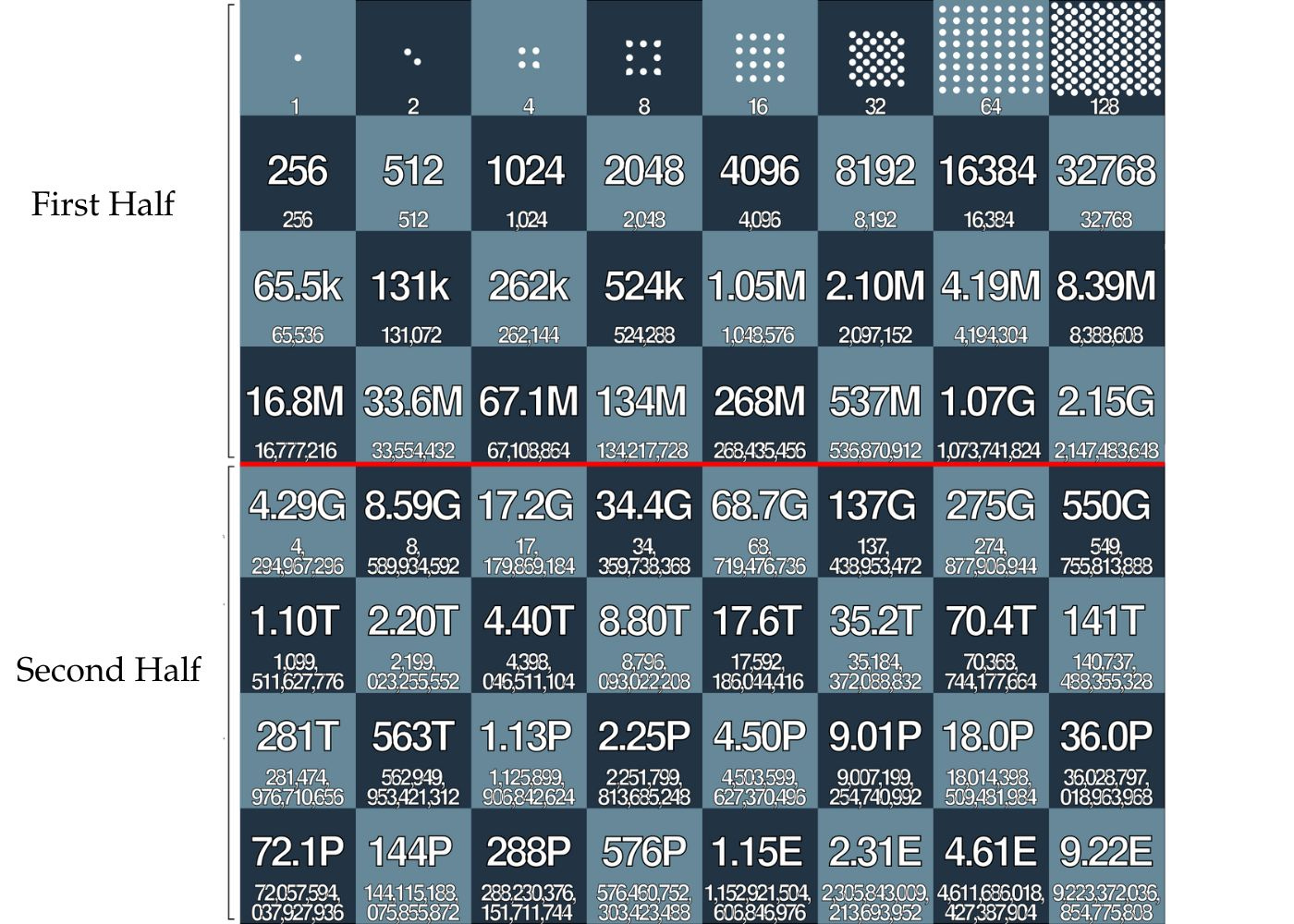
Exponential curves have deceptive flat periods. In the early and middle stages of exponential growth, there are stretches where progress doesn’t feel dramatic because the absolute numbers are still relatively small. The classic example is the chessboard rice problem. For the first half of the board, the growth seems manageable. One grain doubles to 2, then 4, then 8, but by the second half, it becomes explosive.
This misperception of exponential growth isn’t new. In fact, it was first documented in a foundational 1975 study that identified what researchers now call the “exponential growth bias.” This bias refers to the systematic human tendency to underestimate exponential change and perceive it as linear instead. Our minds struggle to grasp the concept of compounding change. We tend to imagine progress unfolding in a straight line, when in reality, it follows a curve that starts slowly and then accelerates beyond what intuition can predict.
Since then, scientists have observed this pattern across nearly every domain of life and decision-making:
Financial decisions: underestimating compound interest and debt growth
Public health: underestimating the speed of epidemic spread
Environmental issues: underestimating the rate of resource depletion
Technology forecasting: underestimating computing and AI progress
Futurist and inventor Ray Kurzweil later called this our “intuitive linear view”. The tendency to project the future as a straight line rather than a curve. It is this blind spot that makes AI’s acceleration so challenging to see.
The Accuracy Plateau
It is true that accuracy gains are slowing down. When GPT-4 came out, it was dramatically better than GPT-3.5. But the jump from GPT-4o to GPT-5 seems to be less noticeable.
GPT-3.5 —> GPT-4:
Math problem-solving accuracy (GSM8K benchmark): 57% → 92%
Reading comprehension scores (MMLU): 70% → 86%
Coding performance (HumanEval benchmark): 48% → 67%
Since GPT-5 is relatively new, public benchmark data are still emerging. These numbers are approximate and based on preliminary evaluations and user reports.
GPT-4o —> GPT-5:
Math problem-solving accuracy (approx.): 70% → 87%
Reading comprehension scores (GPQA Diamond): 70% → 87%
Coding benchmark performance (SWE-bench Verified): 31% → 75%
While GPT-5 shows clear progress over GPT-4o, the leap is less dramatic than the one between GPT-3.5 and GPT-4 (except in coding). I personally don’t use GPT-5 for coding, as I find Claude performs better in this area, so I can’t fully validate its reported coding performance. But for most practical tasks, improvements are not that dramatic.
As many benchmarks approach or exceed human-level performance (85-95%), it leaves little room for further gains. Which makes me wonder:
Is accuracy the right metric to measure AI progress going forward?
Measuring AI’s Progress
When we measure AI’s progress purely by accuracy, by how well a model performs on a single, isolated task at a single moment in time, we miss the essence of what real intelligence looks like.
True intelligence isn’t just about getting one answer right. It’s about staying on task, adapting to new situations, and maintaining coherence across time.
Accuracy answers these questions: “Can it solve this math problem correctly?” or “Can it generate working code for this task?”. But a more meaningful measure might be how long it can continue solving problems correctly.
Accuracy measures performance in the moment. A better measure would show how long that performance can be sustained. This is why measuring AI autonomy makes sense. It captures how long an AI model can maintain strong performance without human intervention.
AI Autonomy
Recently, a non-profit research group called METR (Model Evaluation & Threat Research) proposed a new way to measure progress: the “50% task-completion time horizon.”
This new measure focuses on autonomy. According to METR’s findings, this capability has been growing at an exponential rate over the past 6 years, doubling roughly every 7 months.
Autonomy fundamentally redefines the measurement and implications of AI progress, especially concerning complex and real-world tasks.
Autonomy measures not just what AI can do but how long and how independently it can sustain coherent activity. The 50%-task-completion time horizon is specifically designed to measure and quantify the capabilities of AI systems in terms of human capabilities.
Timeline of AI Autonomy
Time horizon measures how long and complex of a task AI can handle independently. Here is the timeline of this exponential growth:
2019: GPT-2 failed on all tasks taking longer than one minute
2023: GPT-4 and Claude 3 Opus had time horizons in the 5–30 minute range
2024: Claude 3.5 Sonnet had a time horizon of ~30 minutes
2025: Claude 3.7 Sonnet could sustain engagement for nearly 1 hr
If this trend continues, we could see the following progression:
Mid-2026: AI systems capable of approximately 6 hours of autonomous work
Late 2026: AI systems capable of ~12 hours of autonomous work
2027-2028: AI systems capable of ~1-2 days of autonomous work
Late 2028 to 2031: AI systems capable of month-long autonomous work (≈167 hours)
Looking Ahead
If we reflect on what this means, it’s worth asking:
Can exponential growth continue simply through AI maintaining strong performance over longer periods, or will it require entirely new architectures?
Perhaps the answer is both. Exponential autonomy growth could continue through 2026-2027 with current LLM architectures. To maintain the curve beyond that, we’ll need the embodied intelligence that new architectures such as world models can provide.
I hope you enjoyed this article!
If you enjoy my content and want to participate in deeper, ongoing conversations like this, join my newly launched community. The first 10 founding members will receive a complimentary membership 🎉:
If you have any questions, you can message me here:
I think a lot of people get stuck on accuracy because it’s easy to measure.
But accuracy alone misses what actually makes these systems powerful when used well: persistence, scaffolding, iteration, and the ability to support human thinking over time.
A tool that’s imperfect but usable can still meaningfully change what people are capable of, especially when it’s treated as an amplifier rather than a replacement.
The speed is phenomenal but it can also mask some flaws in logic—both machine and human